Circuit modeled after the legendary Roland Jupiter-8 — the flagship polysynth behind some of the biggest records of the 80s. Dual oscillators, cross-modulation, oscillator sync and that huge, glossy analog character, right in your DAW.
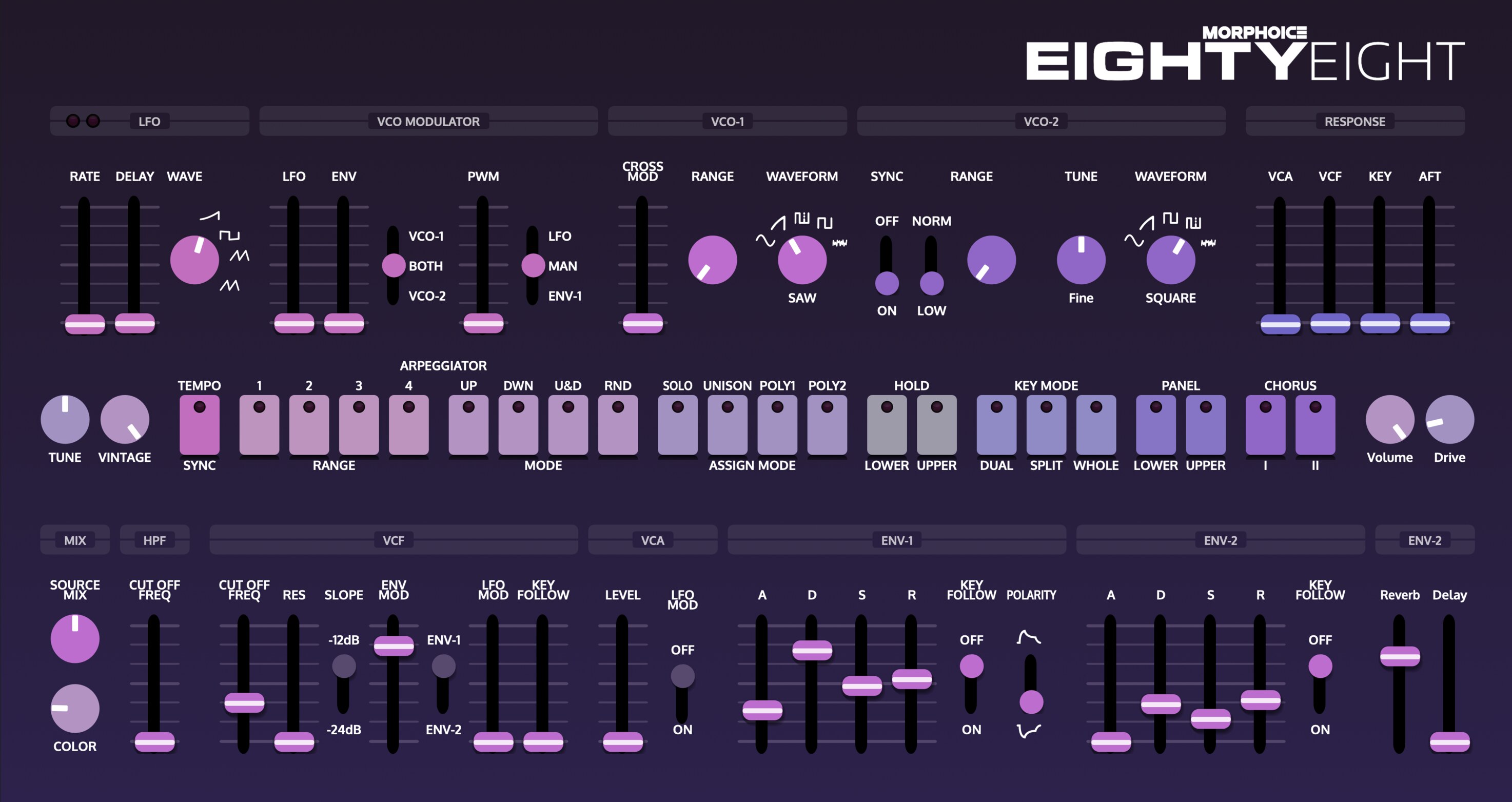
Circuit modeled after the legendary Roland Jupiter-8 — the flagship polysynth behind some of the biggest records of the 80s. Dual oscillators, cross-modulation, oscillator sync and that huge, glossy analog character, right in your DAW.
My Roland JUPITER-8 emulation.
We meticulously modeled the eight vintage voice cards of an old unit, capturing their nonlinearities, detuning, drift and wobble — right down to the DAC scan noise. Each card's filter section carries its own subtle coloration, so no two voices sound exactly alike, just like the real hardware. A VINTAGE slider lets you dial it all in over the idealistically serviced and tuned Jupiter-8 you'd get fresh from the factory — from pristine and pinpoint to characterful, drifting and alive.
Bi-timbral polyphonic synthesizer with two oscillators per voice. Unlike the original, both VCO-1 and VCO-2 offer the full set of waveforms — sine, saw, pulse, square and noise — an improvement over the Jupiter-8. Cross-modulation and oscillator sync are modeled straight from the hardware, the heart of its fat, animated sound.
The full Jupiter-8 voice assigner is modeled. Four ASSIGN modes decide how the voices are handed out: SOLO collapses the section to a single voice with last-note priority and legato re-pitching for tight monophonic leads and trills; UNISON stacks all available voices onto the notes you play and spreads them across the keys as you add more, for a huge, level-compensated sound; POLY 1 is the normal polyphonic mode where every key gets its own voice with full release and first-note priority; and POLY 2 gives superseded notes an instant release — like a piano damper — keeping long-release patches from turning muddy.
On top of that, three KEY modes set up the keyboard itself: WHOLE plays a single patch across the keyboard; DUAL layers two patches across the entire keyboard as two independent synth engines; and SPLIT divides the keyboard into a lower and upper section, each with its own patch — exactly as the original Jupiter-8 does. We doubled the polyphony to 16 voices per layer, still drawn from the eight modeled voice cards.
An accurate model of the Roland IR3109 filter chip at the heart of the Jupiter-8, with resonance and a switchable slope of −24 dB/oct (four-pole) or −12 dB/oct (two-pole), plus a separate non-resonant high-pass filter to thin out the low end. Cutoff can be driven by an envelope, the LFO and keyboard follow. Capable of everything from glassy pads and woody basses to screaming resonant leads.
Two ADSR envelopes, with their timings and curves measured from the hardware so the attack snap and release tail behave like the original. Both are freely assignable: Envelope-1 can shape the pulse width or pitch of either VCO and the filter cutoff, while Envelope-2 can drive the filter cutoff and the amplifier — from tight percussive plucks to slowly evolving pads.
Full performance control: velocity response routable to VCA and VCF, key tracking, glide, and aftertouch — the last two of which the original Jupiter-8's keyboard never offered.
As a bonus we added polyphonic aftertouch on top.
Two independent LFOs, one for the upper and one for the lower section, with sine, saw, square, triangle and random waveforms for pitch, filter and pulse-width modulation. The triangle wave is our addition to the original Jupiter-8 set.
The classic Jupiter sync and cross-modulation capabilities are fully modeled for that signature growl sound. With CROSS MOD, the output of VCO-2 modulates the pitch of VCO-1 — in the audio range this produces ring-modulation-style metallic and clangorous tones, while at low frequencies it turns into LFO-style movement. SYNC locks VCO-2 to the pitch of VCO-1; sweeping VCO-2 sharp of VCO-1 (with the LFO or envelope) generates the harmonically rich, tearing sounds the Jupiter is famous for. Push both together and you get that aggressive, animated growl.
The classic Jupiter arpeggiator with its up, down, up-down and random modes, plus key hold.
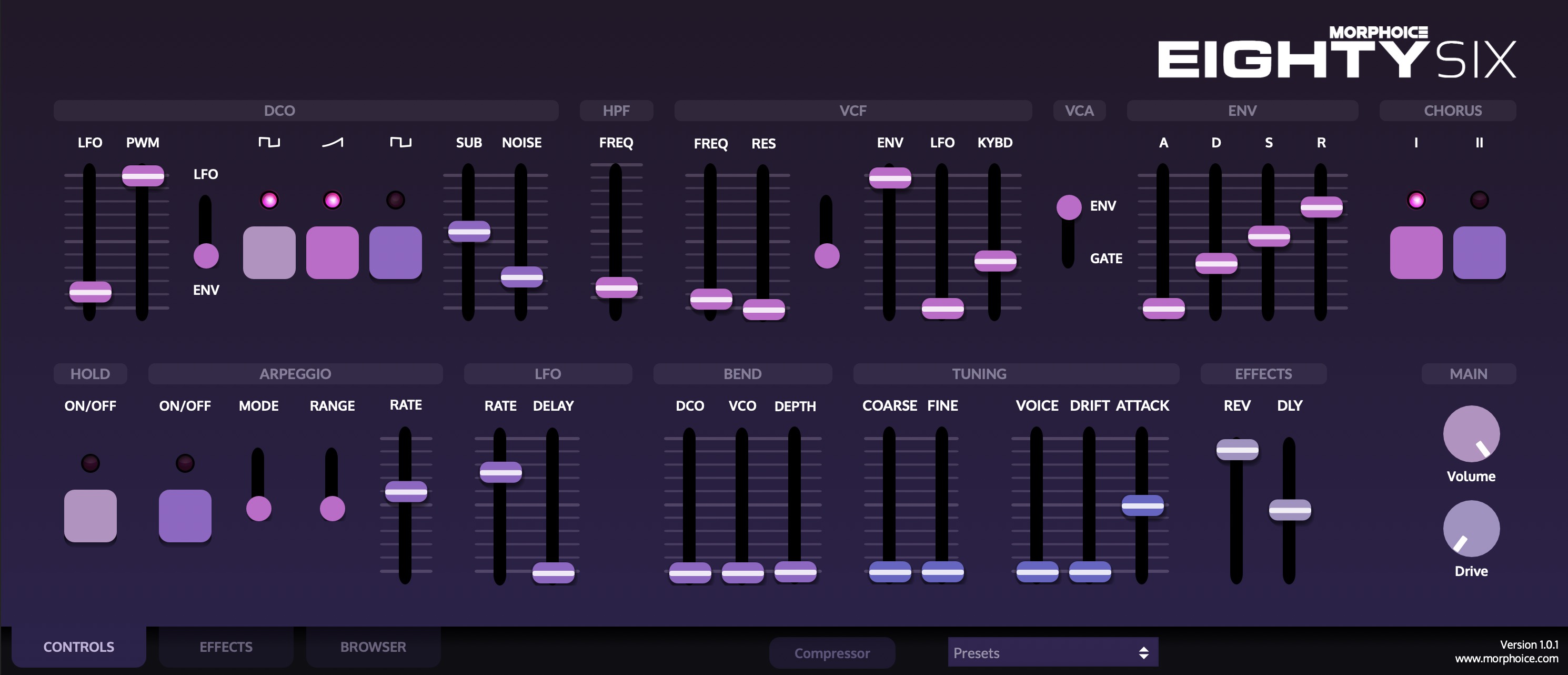
The Jupiter-8 never had a chorus — so we added the Juno-6 chorus from EightySix, measured
from the real hardware, for the lush, shimmering sounds you always wished a Jupiter-8 could make,
including that wonderful BBD noise floor (adjustable) that sounds like a walk along the shore.
EightyEight also features the Strymon BigSly inspired DarkStar Reverb and Tape Delay engine and the HeatBurn Drive/Distortion
to bring your sound to the next level.
Pluckers Dream (bi-timbral)
Split Lead (bi-timbral, solo)
EightyEight is a circuit-modeled emulation built from measurements taken on a Roland Jupiter-8. The oscillators, filter and envelopes are each modeled from the corresponding hardware sections rather than approximated with generic virtual-analog building blocks. We went a step further and meticulously modeled the eight individual vintage voice cards of an old unit — their nonlinearities, detuning, drift, wobble and even the DAC scan noise — so a VINTAGE slider can take you from a freshly serviced, factory-tuned Jupiter-8 to a characterful, aged unit and anywhere in between.
Transfer functions are derived from the actual circuit topology of the original synth, focusing on the sections where component-level behavior is audible — the filter nonlinearity, the cross-mod and sync interaction, the envelope curves. Where component-level precision isn't perceptible, lookup tables and optimizations are used to keep CPU usage reasonable. The DSP is written in Faust.
The voice architecture, filter, envelopes and LFO are modeled from the hardware. The full waveform set on both oscillators is our own improvement over the original. The chorus is the Juno-6 chorus borrowed from EightySix — the Jupiter-8 never had one. The reverb and delay are original additions too: the DarkStar Reverb is a granular shimmer design inspired by the Strymon BigSky and Eventide processors with a smeared, textural character of its own, and the delay is a lofi tape delay with charming wow and flutter.
MAC
macOS Ventura (13.6) or higher
(Apple Silicon Macs supported)
64-bit only
PC
Windows 10 or 11
64-bit only
LINUX
x86_64
64-bit only
VST3 (PC/MAC/Linux), AU (Mac only)

Current version: v1.0.0 (changelog)
Intel & Apple Silicon supported
Enjoyed the trial? To purchase a license click this button:
Roland and the Roland product names mentioned on this page are trademarks of Roland Corporation, used for identification only. Not affiliated with or endorsed by Roland.